
KORG SQ-10 EXTENSION
Back in 1978 the KORG SQ-10 was the preferred sequencer to be used with the KORG MS synthesizer series (such as the MS-10 or MS-20). It provided 12 steps and three channels with variable CV (control voltage) output per each step. The first two channels could be hooked up in a chain to allow a maximum of 24 steps. Back in 1978 the KORG SQ-10 was a great choice for its price. Not only did it look very nice (especially side by side with an MS-10 or MS-20), it was also great fun working with this unique sequencer.
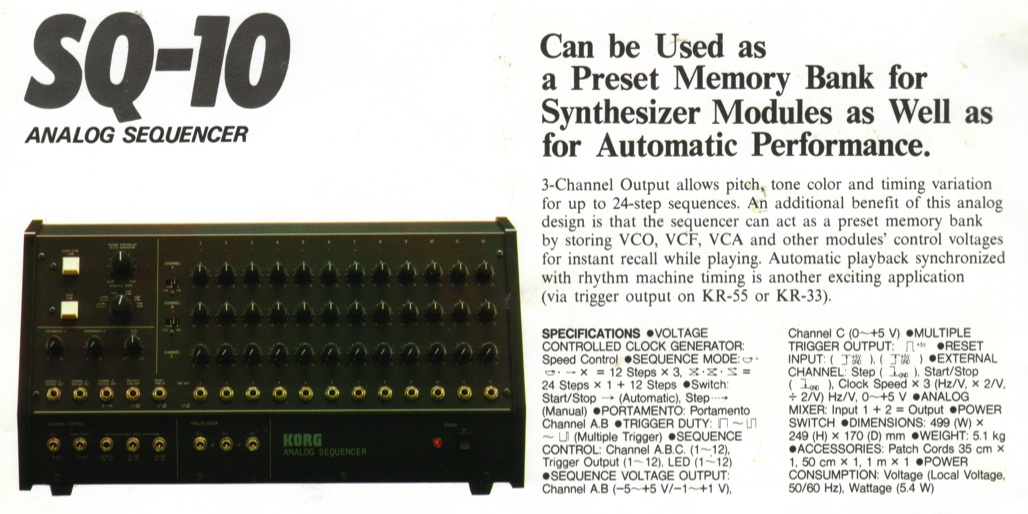
For example there’s the missing step switches. This feature was not that unusual by the end of the 1970’s and it’s really sad that KORG missed the opportunity to add step switches to the SQ-10, which would allow to set mute or reset steps. At least the KORG SQ-10 provided trigger output jacks for each step. With some effort you could wire up your preferred step sequence using these outputs. But that’s not really handy.
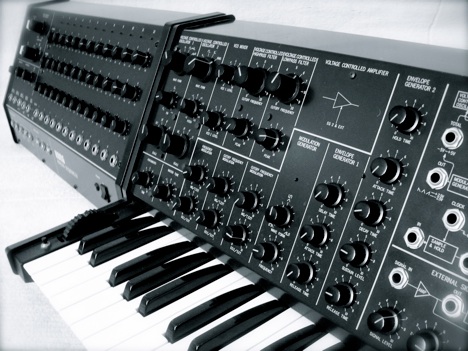
QUADRATSCHULZ SQ10 EXT
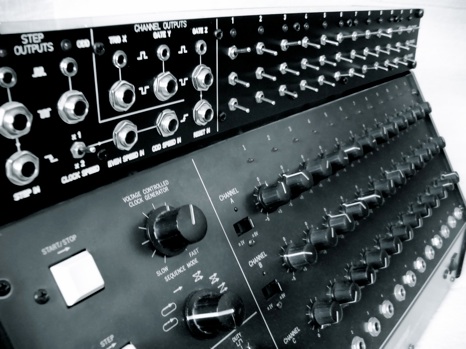
Using the Sync-24 format allows to sync a KORG SQ-10 to other vintage gear, e.g. the ROLAND TR-808. It’s also easy to synchronize with your MIDI equipment using a standard MIDI/Sync interface (e.g. from DOEPFER, KENTON, etc.).
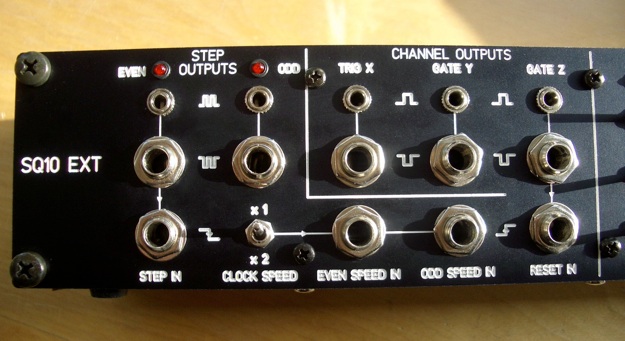
Front panel view of the SQ10 EXT (click image to enlarge):

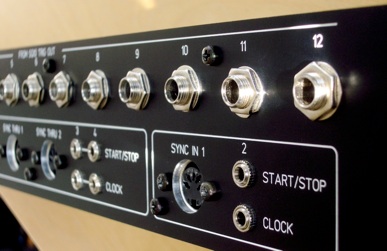
Rear panel view of the SQ10 EXT (click image to enlarge):

Features
-
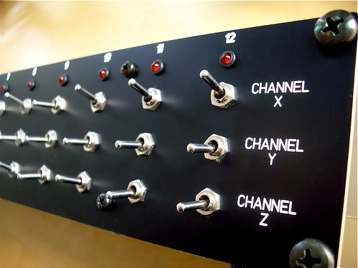
‣Three step sequence channels (X, Y, and Z). Each channel provides 12 step switches, which allows to program three independent sequences à 12 steps.
-
‣Triggered and gated channel outputs,which can be used to trigger short note events or gated (legato) events. The latter can be used to control other units of the SQ10 EXT (e.g. RESET, CLOCK SPEED) or any other unit of a modular system (e.g. ADSR, S&H).
-
‣Non-inverted and inverted outputs for ultimate compatibility with most analog synthesizers. Both 6.3 mm and 3.5 mm jacks allow easy connection to many synthesizers from KORG, ROLAND, MOOG, DOEPFER, etc.
-
‣Built-in Sync-24 synchronizer. The SQ10 EXT allows to run a KORG SQ-10 as a sync slave device to other Sync-24 devices (e.g. TR-808, TR-606). The SQ10 EXT converts the external Sync-24 format to signals that the KORG SQ-10 understands. When an external device is started the SQ10 EXT will also start the KORG SQ-10 from its first step, i.e. the Sync-24 signal is not only used to synchronize the step speed but also to reset the KORG SQ-10 when an external start signal has been received.
-
‣Sync-24 Thru connectors on the rear panel of the SQ10 EXT allow connecting of other Sync-24 devices in a chain. The Sync-24 Thru outputs are internally amplified to provide better signal quality for the connecting slave devices.
-
‣Two independent Sync-24 clock dividers provide even and odd step pulses at two possible speeds. This allows programming of sixteenth, eighth, eighth triplet, and quarter triplet notes. Thus, it is possible to program binary and (ternary) triplet/shuffle rhythms.
-
‣Dual speed clock dividers. Both clock dividers (even and odd) can run at two speeds: normal (x 1) and double (x 2). At normal speed, the even outputs provide eighth note pulses, while the odd outputs provide quarter triplet note pulses. At double speed the outputs provide (even) sixteenths and (odd) eighth triplet note pulses. The clock speed can either be controlled manually with the CLOCK SPEED switch, or with a control voltage that can be connected to the EVEN SPEED IN or ODD SPEED IN jack. It is a good idea to connect the output from one of the gated channels (e.g. Channel Y) to one of the SPEED IN jacks to program tempo changes within the sequence. Switching between normal and double speed is being quantized, so that the speed change will always occur on the next step transition - the SQ-10 will never run out-of sync!
-
‣Pure TTL/HCMOS electronic design. Using only electronic components that were also available, when the KORG SQ-10 was first released. No micro-controller - no MIDI: Optimized for the best possible timing!
-
‣Integrated 230V power supply.
-
‣Vintage panel design inspired by the classic KORG synthesizer design.
-
‣Internally normalized patches for easy operation. Some default connections are patched internally if no plug is inserted into the appropriate jack. The following connections are pre-patched internally:
-
✓The EVEN STEP output is normalized to the STEP IN jack, which connects to the STEP input of the KORG SQ-10. This patch allows that the SQ-10 will run at even steps by default.
-
✓The GATE Z output is normalized to the RESET IN jack, which connects to the RESET TRIG IN of the KORG SQ-10. This default patch allows channel Z to be used to program the reset step.
-
✓The output from the CLOCK SPEED switch is normalized both to the EVEN SPEED IN and the ODD SPEED IN jacks. If no plug is inserted in any of the SPEED IN jacks, the CLOCK SPEED switch allows to manually select the speed (normal or double).
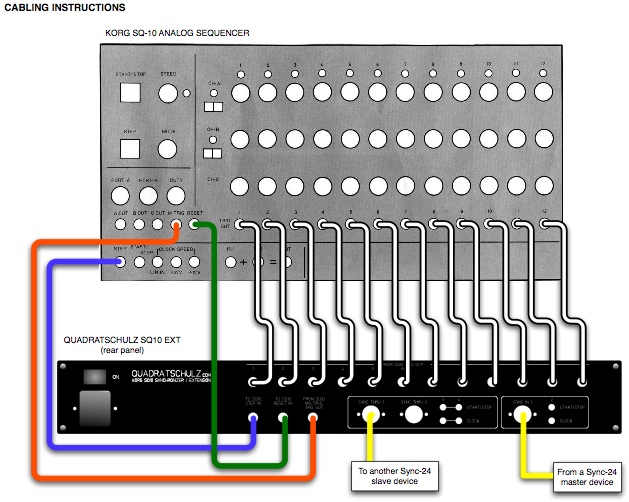
Cabling Instructions
One goal when developing the QUADRATSCHULZ SQ10 EXT was to leave the KORG SQ-10 sequencer intact. Thus, the SQ10 EXT connects to a KORG SQ-10 using its standard jacks. No opening or modification of the SQ-10 is needed. Just patch a few cables between the KORG SQ-10 and the QUADRATSCHULZ SQ10 EXT to extend the capabilities of your vintage SQ-10 without any destructive modification. Here’s how this can be done:
Feedback
Until today, only one single prototype of the QUADRATSCHULZ SQ10 EXT has been manufactured. It is a very compact handcrafted device and putting all the parts together was very time-consuming and expensive. The prototype that is shown on this page is not for sale!
However, if you like this device, please feel free to send me your feedback. If you think, I should do more of this and you’re interested, just email me. If there are enough people who are seriously interested, I will probably produce some more devices.
Acknowledgments
Jan-Hinnerk Helms for all his valuable feedback, help and great ideas during the whole project.
Kalle Tjaben for sharing his fantastic musical knowledge.
Tonio Schmetz for providing great electrophysical measuring instruments.
Arthur Kudella for pointing me to excellent industry panel makers.
Tilmann Schaal for some really beautiful photographs.
Thank you all!
More information
Click here for more Photos - Click here for the Demo Movie
Copyright (c) 2007 by Carsten Schulz - All rights reserved.
A non-destructive extension of an analog vintage sequencer
By Carsten Schulz